

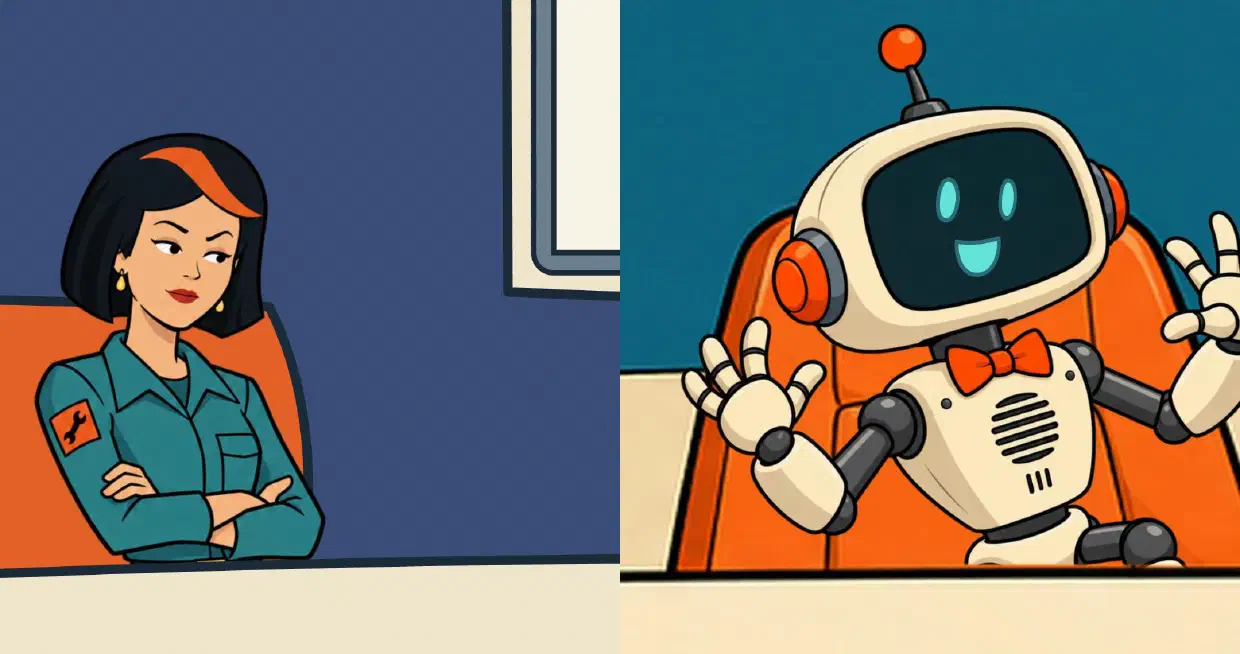
I set out to make an explainer and ended up with a cartoon. Sifted, a robot, was meant to host short videos about how everyday technology works. Somewhere along the way he got an engineer named Vera, a sarcastic mainframe, a pitchman for useless gadgets, and a 1960s TV studio to work in. Then he became the star of his own comedy show.
How the work split
| Tool | What it did |
|---|---|
| Codex | Painted the cast and the sets from my character sheets: poses, mouths, the studio, the control room. |
| Claude Code | Wrote, directed and built each sketch, and ran a writers’ room of agents that pitch, score and punch up ideas. |
| Kokoro | Voiced every draft, free and on my own machine. Each character’s voice came from an audition. |
| HyperFrames | Turned the script, the timing and the art into video. |
My part was the notes: watching every draft and saying what was off.
From code-drawn SVG to painted cels
The art took four tries to get right, in a day.
- A rig. The first Sifted was drawn in code, as SVG on a skeleton ported from a stick-figure playground I’d built, and drawn from my character sheet. He moved, but by rotating joints, and the pilot read as a demo of skeletal animation rather than a cartoon.
- Drawn poses. A 1960s TV cartoon doesn’t bend limbs. It cuts between strong drawings and moves only the face, a head tilt and the odd arm. So the plan changed to a library of poses, and Codex drew the first set, still as SVG.
- The ceiling. SVG written by a model never reached a hand-drawn look.
- Painted cels. Codex generated the poses as images instead, and the build learned to cut each one out, scale it, and find where the face goes. Sifted’s face is a screen, so it swaps on top. Vera’s can’t be left blank for a mouth, so each of her poses is one painting plus edits that change only the mouth or the eyes. The studio became a painted set, with the desk cut out to sit in front of the cast.
What survived from the SVG days is the idea that every part can be replaced on its own: a new pose or a new set drops in without redrawing anything else.
The workflow
- Pitch. Agents write sketches from different angles, and an editor agent picks the best three. I pick one.
- Punch up. One pass: one thought per line, the reveal after the line it explains, a pause where the laugh goes.
- Build. The script, a direction file (who speaks, which shot, what each character does) and the timing become a draft video.
- Notes. I watch it, give notes, and get a new draft. “Robot vs. CAPTCHA” took twelve.
- Publish. I upload it myself.
Where the frustration came in
- The cartoon was wrong for the explainer. It promised entertainment, and the explainer paid off in understanding. Splitting it into its own show fixed both.
- Comedy is timing. Most of my notes were about a pause half a second too short, or two lines running together. The laugh track never landed on the beat, so it came out.
- Most jokes don’t land. Three sketches about a whispering caller were built at the same time, and none of them were funny. The one that worked came from who the character is: a robot asked to prove he isn’t one.
- The tools have limits. The image generator hit its usage cap halfway through a batch of art, and the job waited for the reset.
What’s next
More Shorts, each testing something different, and a name for the show.
HISTORY
- Page started, the day the first Short went up.